
On Writing The Big Picture: Photographing Penguins, 60,000 Images and the Art of Looking


There is something about writing about photography that makes you look at photographs differently.
My latest feature for The Big Issue, for the publication’s ‘The Big Picture’ series, began with a collection of photographs by American conservation photographer Chris Linder.
The subject was southern rockhopper penguins: tiny, fearless birds that spend their summers scaling almost vertical cliffs in the Falkland Islands to reach their nests.
They are also extremely cute. And, as Chris and I discussed, they have a remarkable amount of attitude.
I spoke with Chris over Zoom from Melbourne at 11pm, while it was morning on his side of the world. We talked about penguins, photography, conservation and what it means to spend weeks waiting for a photograph that might only exist for a fraction of a second.
Chris first photographed penguins in Antarctica in 2007, but it was not until 2017 that he encountered rockhoppers in the Falkland Islands. They quickly became his favourite species. Unlike other penguins, which might walk relatively easily from the beach to their nests, rockhoppers launch themselves through crashing waves before climbing cliffs up to 40 metres high.
The photographs capture these moments with an almost cinematic intensity. Penguins appear suspended mid-air, flippers outstretched, waves breaking around them. They look determined, even defiant.
But what I found most fascinating was what happens before and after the photograph.
Chris spent around two weeks in the field, returning to the same rocky position for hours at a time. He was working in wind, rain and sea spray, constantly cleaning his lens and trying not to be swept from the rocks. He estimates that he came home with around 60,000 images.
That completely changed how I looked at the photographs.
What appears to be a single spontaneous moment is actually the result of enormous patience, repetition and attention. Chris might shoot 15 to 20 frames a second as a wave approaches, never knowing whether he has captured the exact moment he was waiting for. The camera becomes a way of freezing something that the human eye could barely register.
We also talked about the tendency to anthropomorphise animals. Rockhoppers stand upright, move almost like children and have surprisingly individual behaviours. Chris told me that they will sometimes walk between his legs or even peck at his tripod while he is photographing them.
But rather than simply projecting human qualities onto them, he sees personality as something that becomes more apparent through sustained observation. The longer you watch an animal, the more you begin to notice its individual behaviours and relationships.
That idea stayed with me while writing the piece.
Chris describes himself as a conservation photographer, and for him, photography is ultimately a way of making science accessible. A beautiful image can catch someone’s attention, but ideally it makes them ask questions: What am I looking at? Why does this matter? What is happening to these animals?
Writing the story became an extension of that process. I was taking images that already told one story and trying to find the words that could open them into another.
The result is a small story about some very small birds, but also about patience, observation and the strange ability of photography to make us look more closely at a world we might otherwise never see.
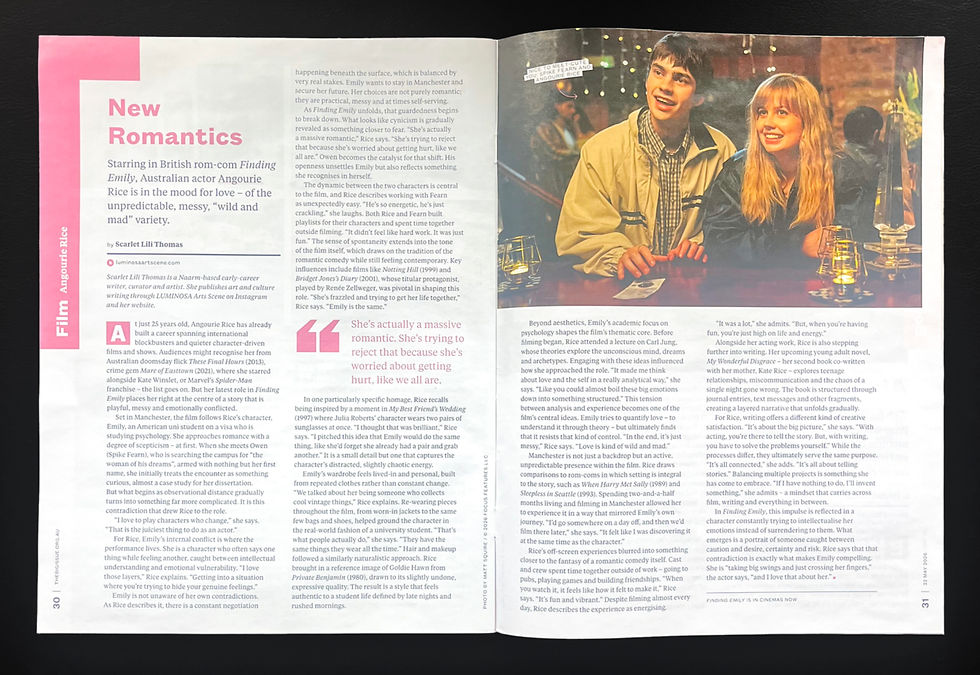
You can read the full feature in The Big Issue, Edition 766 or via the article archive on my website.


Comments