
WORKS
Selected artworks across a range of mediums
RECENT WORKS
The Last Thing She Saw
It begins with an eye. Still, alert, glinting — a portal and a mirror. You can see the hand reaching in its reflection, the act of looking turned back on itself.
Then, something begins to shift. Gently, almost imperceptibly at first — a blur at the edges, a smudge where there was once detail. Over time it spreads. It floats, fuzzes, softens — until there’s no sharpness left. Just fog. Just noise. Just light and loss.
This work came from a place I rarely have language for. A kind of slow dissolving — not all at once, but in quiet, granular ways. The kind of unseeing that comes from seeing too much. The kind of silence that isn’t empty, but overloaded.
Not about blindness.
Not about forgetting.
But about what happens when the self can no longer hold the weight of what the eye has seen.

The Last Thing She Saw
2025
Video, 2 min 22 secs
Capelli (X-ray)
Capelli (X-ray) transforms strands of hair into a mirrored, monochrome anatomy, evoking veins, bones, and internal organs. What begins as an external trace of the body becomes an illusion of its interior — ribs, spine, and chest cavity appearing through reflection and light. The image hovers between clinical detachment and the intimate materiality of the body.
The mirrored structure opens an alternate dimension: part X-ray, part long-exposure light image, part insect or skull form. This ambiguity invites viewers to question where the body begins and ends, and how familiar traces — like hair — hold memory, identity, and vulnerability. In this way, each body is connected.
%E2%80%99.png)
Capelli (X-ray)
2025
Photograph, dimensions vary
PHOTO ASSEMBLAGE: 2024
Pressure Points
In Pressure Points, I explore the quiet tensions and restraints present in domesticity and femininity, using familiar objects and intimate scenes to evoke feelings of vulnerability and pressure.
The composition juxtaposes fragile materials—like cracked eggshells and delicate intimates—with everyday domestic items, such as pegs and washing machines, to reveal an underlying narrative of constraint and release.
At the heart of the assemblage, a femme fatale gazes toward a bright yellow yolk teetering on the edge, symbolising the complex dance between control and chaos. The unhooked bra, tied apron, and blurred motion of laundry cycles mirror the tension between freedom and restriction, while the repetition of eggshells emphasises fragility and impending rupture.
The arrangement of images invites viewers to contemplate the small, unnoticed pressure points woven into the fabric of daily life, creating a visual story that speaks to the fragility of the body and the boundaries of domestic spaces.

Pressure Points
2024
Photograph assemblage, dimensions vary
Marks of Her Flesh
Marks of Her Flesh is an intimate examination of the female body, inviting the viewer to engage with the nuances of skin, scars, and sensory experiences. Each image presents a fragment of the body in isolation, creating a visual dialogue that speaks to the personal and collective experiences of womanhood.
The juxtaposition of hands, marked by small wounds and textured skin, and the stretch marks on the hip, reflect the body's quiet, resilient narrative—each scar and line telling a story of endurance and transformation. The female gaze—captured in the close-up of a woman's eye—encourages the viewer to reflect on their role in the gaze, challenging the objectification of the body while reclaiming ownership of it. Lips, smeared with raspberry and the exposed nipple at the centre of the composition highlight both sensuality and vulnerability, while the twisted tongue and bitten lips speak to tension and restraint.
The raspberries—smashed, dripping, and smudged—symbolise menstruation, womanhood, and the traces left on the body through intimate, everyday encounters. The red juice staining the hand mimics blood, pointing back to the body's role as a vessel of life, vulnerability, and transformation.

Marks of Her Flesh
2024
Photograph assemblage, dimensions vary
Beneath the Surface
Beneath the Surface is a close examination of the textures and imprints within the kitchen, drawing attention to the hidden materiality and quiet transformations involved in everyday food preparation. By focusing on the tactile and sensory qualities of ordinary ingredients and utensils, this work reveals the intricate patterns and subtle traces that often go unnoticed.
Each image in this assemblage captures a fragment of the kitchen’s landscape, from the stiff bristles of a broom to the scored surface of a chopping board, or the bubbling water surrounding gnocchi. These close-up perspectives emphasise the depth and complexity of simple, familiar objects—dry strands of spaghetti, porous bread, and kneaded dough, each marked by the hand's touch.
The work plays with contrasts—between frozen salmon sealed in ice and rosemary, and the rich, swirling mixture of butter, sugar, and vanilla in a mixer. The frothy foam on hot chocolate, the curves of cabbage leaves, and the sticky residue of berry compote all reveal the tactile traces left behind. Beneath the Surface invites viewers to look beyond the obvious and contemplate the intimate, sensory experiences embedded in the kitchen, uncovering layers of meaning beneath the seemingly mundane rituals of cooking.

Beneath the Surface
2024
Photograph assemblage, dimensions vary
SELECTED PHOTOGRAPHS: 2024
Marks of Domesticity Series
In this series, I delve into the intimate world of the home, exploring the textures, colours, and forms that define our domestic landscapes. Through close-up macro photography, I capture the overlooked details of everyday life—food, utensils, and surfaces that bear the marks of lived experience. The kitchen becomes my canvas, a symbol of both nurturing and constraint, where tradition and rebellion coexist.
The vivid colours and intricate patterns in these images reflect the tension between the familiar and the abstract, creating a visual language that speaks to womanhood and feminism. Each photograph offers a glimpse into the unseen beauty and complexity of domestic life, while subtly questioning the roles and expectations placed on women within these spaces.
By focusing on the overlooked marks and traces of domesticity, I invite viewers to reconsider the kitchen as more than a functional space. It is a site of creation and repetition, a realm where identities are shaped, and histories are etched into everyday objects. These images celebrate the richness of domestic textures while challenging the boundaries between the personal and the political.


Femme Traces Series
In Femme Traces, I explore the intersections of womanhood, the female body, and the domestic sphere through a series of intimate close-ups. This body of work captures the traces left behind by the everyday—intimates like bras, blurred clothes spinning in a washing machine, pegs, stretch marks, and scars, revealing how the female body and its presence are interwoven with the rhythms of domestic life. These everyday objects become stand-ins for larger narratives, highlighting the quiet, often unnoticed, yet powerful traces women leave in their surroundings.
From the soft textures of lips and hands to the visceral mess of smushed raspberries referencing menstruation, Femme Traces delves into the cyclical, repetitive nature of care work, the impermanence of existence, and the invisible labour that binds the home. The cracked egg yolk, photographed over an article on femme fatales and the traces of makeup allude to the layered experiences of being both nurturer and subversive figure, of inhabiting both fragility and strength.
Through this series, I draw attention to the relationship between body and space, between care and confinement, using the domestic environment as a canvas to explore broader conversations around femininity, identity, and resistance.


PRINTMAKING AND PHOTOGRAPHY: 2024
Layers of Saturation
Layers of Saturation delves into the interplay of organic textures and manufactured patterns, transforming everyday kitchen items through the process of printmaking. At its core, the installation’s foundation—a wall partition titled Alizarin Crimson Coloured Lemon Wallpaper Ed. 1—features dried lemons stamped in alizarin crimson acrylic, forming a tactile, repetitive surface that reflects the handmade mark of domestic labor.
Cropped, macro photographs of household textures punctuate the wall: a sponge with porous pink cavities and a cabbage’s veined purple skin evoke organic cellular structures, each placed at varying angles to integrate seamlessly with the layered wallpaper. These images create a dialogue between organic form and the imprinted patterns, intensifying the sense of immersion within the installation.
In a palette of pinks, deep reds, and purples, A4 prints stamped with food items—lemons, grapefruit, leek, lemongrass, and broccoli—mirror the installation’s botanical roots and domestic familiarity. Each print carries a tactile memory of the kitchen, bridging the gap between the intimacy of home and the public space of the gallery. Layers of Saturation invites viewers to engage with the quiet beauty found in everyday materials, where ordinary imprints form a richly layered narrative, honouring the resilience and tactile history embedded within domestic spaces.

Layers of Saturation (detail of installation)
2024
Dried fruit and vegetables, acrylic paint, stamped on A4 paper and wall partition, with two photographic prints
Dimensions vary
PRINTMAKING: 2024
These printmaking and stamping artworks explore the traditional roles of women within domestic spaces, focusing on the kitchen and home as sites of both nurturing and confinement. By examining the textures, colours, and forms of food and household objects, I challenge conventional perceptions of the kitchen, transforming it into a metaphor for the cyclical nature of domestic life and the impermanence of existence.
The prints, created from vegetable scraps highlight the intricate relationship between people and food while questioning the expectations placed on women within these spaces.
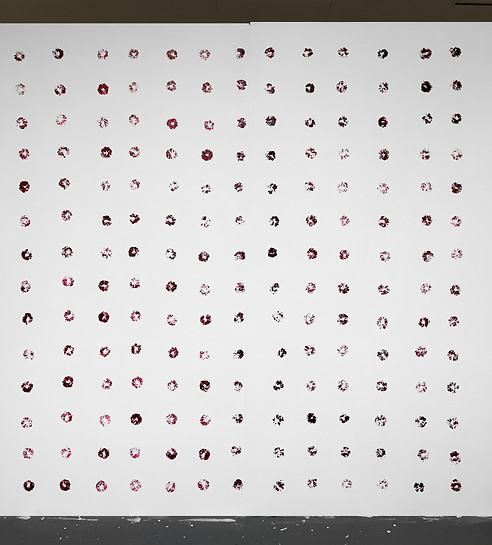

Alizarin Crimson Coloured Lemon Wallpaper Ed. 1 (wall partition)
2024
Dried lemons and acrylic paint, stamped directly onto the wall
Dimensions vary

Lemon Stamp Series
2024
Dried lemons and acrylic paint on paper (4 sheets, A4)

Broccoli Stamp Series
2024
Dried broccoli stem and acrylic paint on paper (2 sheets, A4)

Leek Stamp Series
2024
Dried leek stem and acrylic paint on paper (2 sheets, A4)
EARLIER WORKS
Cane Chair
Cane Chair is a portrait drawing of my aunt Annie, who has Rett syndrome, a rare genetic neurological disorder. This work delves into our relationship and the profound impact of Annie's disability on our family dynamics. As I grow more independent, her increasing dependence on others becomes a poignant aspect of our connection.
In creating this artwork, I aimed to capture Annie’s vulnerability and fragility. The vibrant colours of her clothing sharply contrast with her facial expression and the tension in her hands gripping the scarf at her neck, emphasising both her solitude and resilience.
This artwork is especially meaningful to me, inspired by a desire to express affection for Annie in ways that transcend words, given the challenges she faces in communication. I sought to convey the emotional depth of our relationship and reflect our growing interdependence as life unfolds.

Cane Chair
2021
Coloured Pencil
29.7 x 21.0 cm (sheet)
Featured in: Top Arts 2022, National Gallery of Victoria