
“Be My Valentine”: Girlhood, Desire, and Disappearance at Hanging Rock


Every February 14, we rehearse the same ritual. Pink cards. Lace. Flowers. The language of possession disguised as devotion: Be mine.
Valentine’s Day is framed as soft, sentimental, harmless. But embedded within its rituals is something older — a quiet rehearsal of heterosexual destiny. To be chosen. To be admired. To be desired. The card is not just affection; it is a claim.
In 1900, on St Valentine’s Day, a group of schoolgirls climbed Hanging Rock. Some never came back.
Picnic at Hanging Rock (1975), directed by Peter Weir and adapted from Joan Lindsay’s 1967 novel, transforms Valentine’s Day into something uncanny. The film is not about romance; it is about disappearance. And yet it is saturated with longing — longing from men, longing between girls, longing for something that cannot be named.
The film asks a question Valentine’s Day never does: What if a girl refuses to be chosen at all?
The Performance of Girlhood

At Appleyard College, femininity is rehearsed like a discipline. The girls are corseted, gloved, encased in white muslin that resembles both communion dress and bridal gown. The costuming is deliberate — high collars, fitted waists, ribbons. They recite French. They practice posture. They are instructed in deportment and refinement. They are being prepared — not for adventure, not for intellectual autonomy — but for presentation, for marriage.

The mise-en-scène inside the college reinforces this containment. Heavy Victorian furniture crowds the frame. Floral wallpaper presses inward. Mirrors recur throughout the film, quietly doubling the girls’ images. They are reflected, refracted, split. The mirror does not simply show them who they are; it reminds us they are always being watched — by the institution, by men, by the camera itself.

The film is set at the turn of the century — 1900 — a temporal threshold. The end of the Victorian era. The beginning of modernity. A cultural shift humming beneath corsetry and colonial propriety. The year itself feels symbolic: something is about to rupture.
The Valentine’s Day picnic is supposed to be charming. A supervised outing. A controlled exposure to nature. Yet even before the disappearance, the atmosphere destabilises. The girls eat cake beneath filtered sunlight. Ants later crawl across the icing — sugary, ornamental, faintly grotesque. The sweetness is invaded. Clocks stop at midday. Time itself seems to suspend. Everyone falls into a strange, collective sleep.
Romance curdles into unease.

Miranda — luminous, almost mythic — floats through the film like an apparition. She is described by Mademoiselle de Poitiers as “a Botticelli angel.” The line is not accidental. Botticelli’s women are ethereal, distant, suspended between flesh and divinity. Miranda is framed in soft focus, often haloed by light. The film’s gauzy diffusion filter bathes her in an amber glow, washing the palette in creams, golds, and pale blues. She is less person than vision.
Michael Fitzhubert’s fixation after her disappearance only intensifies this transformation. He clutches a fragment of lace as if it were a relic. Valentine’s Day promises love; the film delivers obsession. Miranda becomes most powerful once she is unreachable — frozen in absence, preserved in fantasy.
Cinema has long taught us that a woman’s value increases when she becomes idealised, distant, untouchable. Miranda is no longer a girl; she is a projection.
The Rock as Refusal

Hanging Rock is volcanic, ancient, indifferent. It predates British settlement. It predates the school. It predates Valentine’s cards and corsets. Against its rough, shadowed surfaces and greenery, the girls’ white dresses look impossibly fragile — pure, virginal, bridal. The visual contrast is stark: colonial delicacy imposed upon Indigenous land.

The film feels dreamlike, almost hallucinatory. Weir uses slow motion, elongated pacing, and a technique often described as double exposure — layering images softly so that forms appear to bleed into one another. Faces dissolve into rock formations. Light flares across the lens. The boundaries between body and landscape blur. This is not a horror film in the conventional sense, but it carries the dread of one. The terror is atmospheric, not violent.
The music deepens this instability. Zamfir’s pan flute drifts across scenes like breath — cyclical, hovering, unanchored. It refuses dramatic crescendo. It suspends us.

When Miranda, Marion, and Irma climb higher — with Edith trailing behind — they begin removing their gloves and stockings. The gesture is subtle, but radical. Gloves signify civility. Stockings signify modesty. To remove them is to shed discipline. To step barefoot onto rock is to feel something older than propriety.
The last image of Miranda seen by Mademoiselle de Poitiers — blonde hair illuminated, body poised in stillness — feels almost sacred. Then she disappears behind stone.
The landscape does not romanticise them. It swallows them.
The police later theorise a male perpetrator — perhaps a bushranger, perhaps a madman lurking in the wilderness, perhaps even Michael Fitzhubert. The impulse is telling. Faced with female disappearance, authority reaches for a familiar narrative: a man must have done this. Violence must be masculine, external, explainable. The possibility that the girls slipped beyond patriarchal comprehension is more unsettling.

The film never explains what happens. And that absence matters.
Joan Lindsay did write a final chapter — later published as The Secret of Hanging Rock — that offered a metaphysical explanation involving folds in time and space. In it, reality itself fractures. But her publisher insisted it be removed from the original novel. Mystery was preserved.
The refusal of explanation is political. The girls are not returned to narrative order. They are not punished on-screen. They are not married off. They are not rescued.
They are simply gone.
What if disappearance is the only available form of autonomy?
Edith, Sarah, and the Girls Who Stay
Edith Horton returns screaming, hysterical, disoriented. She becomes the sanctioned witness, yet her testimony produces no clarity. She is dismissed as overwrought. Her fear is feminised, trivialised. She survives, but survival brings no authority.
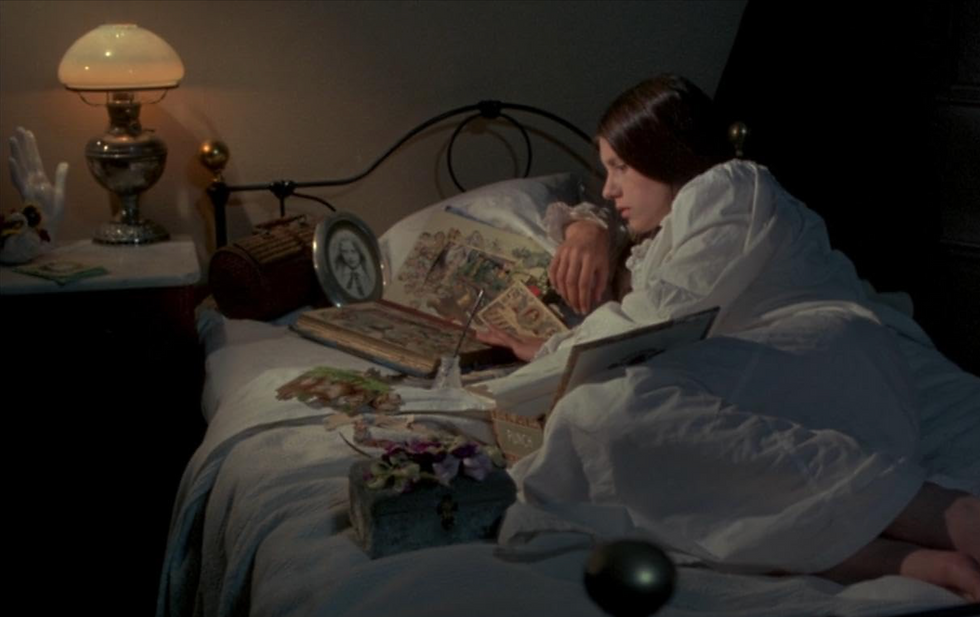
Then there is Sarah Waybourne — the orphan who is forbidden from attending the picnic. Sarah’s attachment to Miranda is intense, devotional. She calls her an angel. She keeps tokens of affection. Her longing trembles on the edge of something romantic, though it remains unnamed.
If Miranda represents transcendence, Sarah represents confinement.
Denied the rock and denied Miranda, Sarah is left within the suffocating walls of Appleyard College. The mirrors return. The corridors narrow. Mrs Appleyard’s authority tightens. Where Miranda slips into myth, Sarah collapses under repression.
The film allows queer undercurrents to pulse quietly beneath the surface. The girls brush each other’s hair. They recline together in dappled sunlight. They exchange glances that linger too long. Valentine’s Day insists on heterosexual pairing; the film suggests desire does not move so neatly.
Desire circulates — between girls, between teacher and student, between absence and obsession.
The 2018 Series: Reframing Desire and Power

The 2018 television adaptation pushes these tensions forward. Marion is portrayed by Indigenous actress Madeleine Madden, reconfiguring the colonial landscape of the original. The presence of an Indigenous girl at the centre of the narrative unsettles the whiteness of Appleyard’s world and reframes the Rock not merely as backdrop, but as land with history and ownership.
The series also renders explicit the romantic attachment between Miss McGraw and Marion. Miss McGraw’s decision to follow the girls is no longer abstract intellectual curiosity — it becomes longing. The repression is named.
By foregrounding queer desire and colonial tension, the adaptation surfaces what was latent in Weir’s film: the Rock is not simply a site of mystery, but a rupture in systems of control.
True Story or Beautiful Lie?
For decades, audiences believed the story was based on real events. Joan Lindsay was evasive in interviews, allowing speculation to flourish. She had attended school near the region; Hanging Rock was real; the date was precise. Tourism increased. The myth thickened.
But whether it “really happened” is almost irrelevant. The story endures because it reflects something structurally true: that girlhood is often a site of projection, containment, and aestheticisation.
And sometimes, rupture.
Valentine’s Day and the Politics of Being Chosen
Valentine’s Day is about being selected. Desired. Claimed.
Be mine.
The phrase implies ownership. It suggests that love is acquisition.

In Picnic at Hanging Rock, the girls slip out of that economy entirely. They do not become wives. They do not become mothers. They do not grow into respectable Edwardian women shaped for marriage markets.
They vanish before the script can complete itself.
The men are left searching. The police construct rational explanations. The institution collapses. Mrs Appleyard, clinging to order and moral rigidity, ultimately falls from the Rock herself — Victorian authority undone by the very landscape it sought to tame.
What unsettles audiences is not simply the mystery, but the suggestion that structures designed to shape women cannot fully contain them. That beneath lace and etiquette and Valentine cards, there is something wilder.
On that St Valentine’s Day in 1900, romance gave way to rupture.
The card says: Be mine.
But the Rock whispers something else.
Some girls, the film suggests, choose not to be possessed at all.


Comments